| To work for the proper implementation of canon law is to play an extraordinarily constructive role in continuing the redemptive mission of Christ. Pope John Paul II |
| |
| | |
| | |

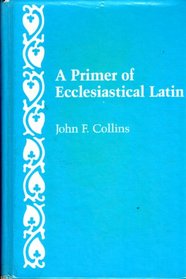
| Resolution 1152 x 864 | Updated 28 feb 2016 | Collins' Primer of Ecclesiastical Latin |
| Overview
This page no longer maintained. nov 2023 |
|
| Who is interested in Collins' Primer?
| Three groups are interested in Dr. Collins' Primer, namely:
Students enrolled in formal courses using Collins' Primer should use the text as directed by their teachers though what follows here might be helpful as a supplement. Home-schoolers and other independent (but supervised) learners, and in particular the tutors of these independent learners, might also find what follows here useful; indeed, it is chiefly these kinds of Latin learners that I had in mind while developing this page. |
|
|
| Those who think, however, that they can learn Latin on their own by working through Collins (or, for that matter, any other textbook) should probably abandon that plan. |
|
| In 30 years of watching and working with Latin students of every sort, I have never found anyone who, knowing only an "analytic" language such as English or French, actually learned a "synthetic" language like Latin from a textbook. Many have tried, and failed, and walked away--not from their futile methodology, but from Latin itself. That's a pity. Most people can learn Latin if they use a workable approach, but setting off into the wilderness with only a textbook as a guide is not a workable approach. Even those who know a Romance language like Spanish, and so have a head start in terms of Latin vocabulary, still must learn Latin grammar & syntax, both of which differ markedly from English and Spanish.
| Can anyone learn Ecclesiastical Latin on their own? Sure: angels, followed by people who know Classical Latin, Koine Greek, or certain modern languages like German, can learn Ecclesiastical Latin from a textbook. Everyone else needs a teacher or a tutor. |
| Et ego, quis sum? | I am not a classically trained Latinist. I am a lawyer, civil and canonical, and it was during graduate studies for the latter that I began to study Ecclesiastical Latin seriously. Our textbook was the very first edition of Collins. I took three intensive Latin courses in grad school and loved them all. Intermittently for five years after that, but almost daily for the last twenty years, I have used Ecclesiastical Latin in my canonical work, have continued to study it formally and informally, and have taught it to a wide variety of students. Specifically in regard to teaching experience, I began tutoring home-school students (using Collins) more than twenty years ago; for the last ten years I have been teaching college-level Beginning and Intermediate Latin at Sacred Heart Major Seminary, again mostly out of Collins. My desk copy of Collins' Primer is the same book I used in grad school. It is now held together by duct tape.
|
| Some preliminary points about Latin
| 1. Classieen Classical and Ecclesiastical Latin.
2. "Ecclesiastical Latin", "Church Latin", and "Medieval Latin", are basically three terms for the same thing. For more information, see this page.
3. Latin is, of course, an oral-aural language and thus it is best learned by listening to and speaking it, and later, reading and writing it. Of course, very few persons can pursue this approach, but the Family of St. Jerome promotes it. Besides offering a variety of recorded and printed material (including Carmelite Fr. Suitbertus Siedl's Cursus Linguae Latinae Vivae), the FSJ sponsors annually a "Cenaculum" or "Feriae Latinae" during which Latinists of all levels (from world-class masters to complete beginners) meet for one week to develop their Latin listening and speaking skills. I have attended several FSJ Cenacula over the years and learned a great deal at them.
|
| Basic learning tips | 1
2. Virtually all students of a foreign language need to study that language nearly every day--and that means study outside of class! The great majority of Latin students will benefit by the following approach: (a) devote one serious block of time (usually an hour) every day to the uninterrupted study of whatever aspect of Latin is currently being presented in class; then, (b) devote about that same amount of time each day to a series of short (five or ten minute), focused reviews of Latin throughout the day. Combining frequency of exposure to a language throughout the day with a daily dose of extended language study is a very effective combination.
3. Finally, besides a daily concentrated block of study time and several short bursts through the day for review, Latin lends itself well to "micro-burst" learning. For example, during my early studies, I always carried a Latin declension or a conjugation on a 3x5 card in my shirt pocket (not in a briefcase, not in a wallet, but in my shirt pocket, where I could access it in two seconds!). Then, while, say, climbing the stairs or waiting in a line, I would silently recite the paradigm and, if I got stuck, I could pull the card out and check it immediately. There is considerable 'downtime' in the course of a normal day, Latin students can make great use of those breaks.
|
| More learning tips
I will offer more learning tips below. These are offered to help get one started on the right foot. | 1. Students of Ecclesiastical Latin should begin learning their basic prayers right away even if, as is inevitable at first, the vocabulary and/or syntax of these prayers is unknown. Start with the Sign of the Cross and gradually add the others. Say these prayers in Latin, aloud, whenever possible to develop facility and confidence. Students can later draw on these prayers for many examples of grammatical and syntactical points.
2. Students must memorize Latin "forms" (noun declensions, verb conjugations, and so on) as soon as they are encountered and review them frequently. Remember that recognizing a form is not the same thing as knowing a form. Forms are not known until they can be produced on demand, out of order; they are not known well until they can be consistently used correctly in translation work. This takes time.
3. As soon as possible students should begin turning English into Latin even if their primary goal in learning Latin is, as is likely, simply to be able render Latin into good English because one of the best ways to achieve Latin-into-English competence is to practice rendering English into correct Latin. I strongly recommend that students try the English-to-Latin exercises offered in Collins. As a rule of thumb, 10 or 15 minutes of spent turning English into Latin is worth 30 or 40 minutes of translating Latin into English.
|
| How to use this page |
|
| Final note |
|
| Chapter One
The | 1. Pronunciation.
For my discussion of where the accent/stress falls in most Latin words, see this page. the meaning of the prepositions and what case(s) they take right away. |
| Chapter Sixteen |
| Chapter Seventeen |
| Chapter Nine | 101. Fsatives. Ok.
| Any chapter that presents the vocative case and the imperative mood simultaneously cries out to be illustrated by the great prayer, Anima Christi [Soul of Christ]
Anima Christi, sanctifica me. Corpus Christi, salva me. Sanguis Christi, inebria me. Aqua lateris Christi, lava me. Passio Christi, conforta me. O bone Jesu, exaudi me. Intra tua vulnera absconde me. Ne permittas me separari a te. Ab hoste maligno defende me. In hora mortis meae voca me. Et iube me venire ad te, ut cum Sanctis tuis laudem te, in saecula saeculorum. Amen.
|
| C | 121. Present subjunctives of esse and posse. Ok.
122. Emph
123. Unemphatiour call.
xxxxxWhen going from English to Latin, moderns are tempted to overuse is, ea, id, as subjects for verbs. Recall th
12
Vocab Notes.
Readings.
The Nic | ||||||||||||||||||||||||||||||||||||||||||||||||||||||||||||||||||||||||||||||||||||
| F | You never finish learning Latin. At some point, you just stop. Fr. Reggie Foster |