| To work for the proper implementation of canon law is to play an extraordinarily constructive role in continuing the redemptive mission of Christ. Pope John Paul II |
| |
| | |
| | |
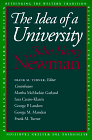
| Resolution 1152 x 864 | Updated 13 jan 2013 | Review of John Henry Cdl. Newman, The Idea of a University (Yale, 1996) 400 pp |
| Edward Peters, Review of John Henry Cdl. Newman, The Idea of a University [=], in National Catholic Reg. (9-15 Feb 1997) 6.
| John Henry Cardinal Newman (1801-1890) is not an easy read. I doubt he ever was one, but the passage of 150 years since the first appearance of his essays on the university have only, worked to make him less accessible. The sentence that opens Part 9 of Discourse VI, for example, runs more than 200 words. I challenge anyone to read it once and know for sure which of two university models Newman prefers. Read it twice if you wish, the bet still stands.
Nevertheless, the ideas which Cardinal Newman formulated regarding the university are much more important today that they were in his own time. This is true because they apply to Catholic universities, and more specifically to English-speaking Catholic universities, which today represent well more than half of the world's Catholic colleges and universities. Could Newman have had any premonition of the phenomenal growth that the Roman Catholic Church would experience in the common law nations descended from England?
The historical background for The Idea of a University is well known. Newman, a famous Oxford don recently converted to Catholicism (1845), was asked by the archbishop of Dublin to come to Ireland to establish a Catholic university. This spurred Cardinal Newman to deliver a series of lectures, supplemented later by several essays, on the nature of a university He reworked the original corpus of lectures and essays many times during his life, even long after he had left the Irish Catholic university (1858)—a project that ultimately failed for reasons generally understood to have been beyond the cardinal’s control. But his lectures and essays on the university lived on and, for more than a century now, have charted the high road, albeit the road ever less traveled, of academe.
We should be grateful to Dr. Frank Turner and Yale University for publishing Cardinal Newman's The Idea of University as part of its "Rethinking the Western Tradition" series. Five fascinating essays by modem scholars follow Newman's materials, and Turner himself provides a fine orientation, synopsis, glossary, and bibliography. All of this is neatly laid out in an attractive and readable edition.
Cardinal Newman's idea of a university is startlingly simple. In his own words and emphasis, "it is a place of teaching universal knowledge." The cardinal's relegation of research to the fringes of academic life might well seem impractical today, as governmental, commercial, and philanthropic research funds keep the doors of many universities open. But his emphasis on the primacy of teaching is refreshing in an age marked by a publish-or-perish climate.
But it is Newman's commentary on the role of the university in promoting knowledge, specifically universal knowledge, which today sounds such a crucial chord in the debate surrounding the nature of universities in general, and the role of Catholic colleges and universities in particular: In a little more than two generations, the greatest universities have been transformed from institutions where answers could be found (yes, sometimes, incorrect answers) to places where any question, no matter how shallow, irrelevant, or misinformed, can be posed Against this backdrop, of course, had stood the Catholic universities, particularly in the United States, which for a while had upheld the idea that theology was a field of human knowledge and hence deserving of a place in any university worthy of the name.
Just at the time, however, when the secular universities were losing their nerve in the wake of the revolutionary 1960s, the Catholic universities, caught in the turmoil of Vatican II lost, if not their faith, at least their convictions. Newman would have held fast to his belief. "[The university] cannot fulfill its object duty, such as I have described it, without the Church's assistance; or, to use the theological term, the Church is necessary for its integrity. Not that its main characters are changed by this incorporation: it still has the office of intellectual education; but the Church steadies it in the performance of the office." Would that he were always so clear.
|