| Thomas More Prayers, here | To work for the proper implementation of canon law is to play an extraordinarily constructive role in continuing the redemptive mission of Christ. Pope John Paul II |
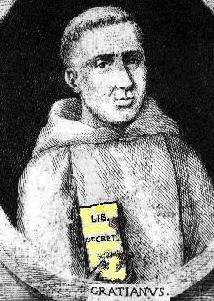
| Gratianus Iuris Canonici Pater | CanonLaw.info
Homepage and Resource Center of Edward N. Peters, JD, JCD
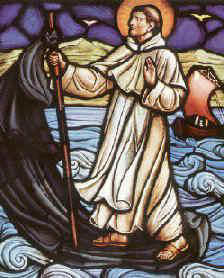
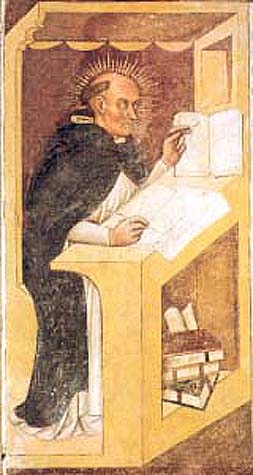
| Dr. Peters | Raymond Peñafort Patron of Canonists |

| Overview
| This website provides information about the content and operation of canon law in the Catholic Church and assists canonists and other researchers toward locating and assessing canonical materials.
|
| Canon Law in general
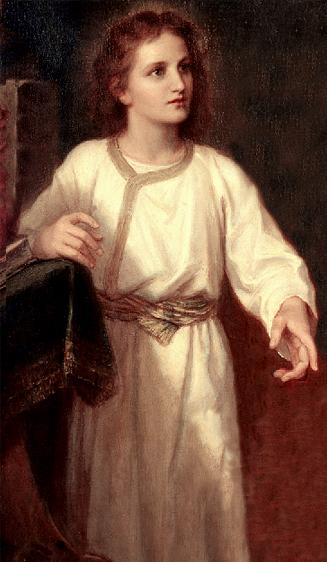
Invenerunt illum in templo sedentem in médio doctorum, audientem illos et interrogantem eos; stupebant autem omnes, qui eum audiebant, super prudéntia et responsis eius. | Canon Law, the oldest continuously functioning legal system in the Western world, is the internal legal system of the Catholic Church:
• Internal: canon law lies wholly within the Church's authority to compose and administer, this, in contrast to the wide variety of external (usually civil) laws to which the Church generally defers in the pursuit of her divine mission;
• Legal: canon law operates according to the principles of law chiefly as set out in Aristotelian-Thomistic legal philosophy, this, in contrast to suggestions that canon law is simply applied theology, morals, or the rules of religious cult;
• System: canon law must be read as a whole for proper understanding and use, this, in contrast to suggestions that canon law is a collection of principles or aphorisms that are capable of being rightly appreciated in isolation from each other.
Canon law affects virtually every aspect of the faith life of over one billion Catholic Christians around the world. But, as Pope St. John Paul II explained when he promulgated the Code in 1983, canon law "is in no way intended as a substitute for faith, grace, charisms, and especially charity in the life of the Church and of the faithful. On the contrary, its purpose is rather to create such an order in the ecclesial society that, while assigning the primacy to love, grace, and charisms, it at the same time renders their organic development easier in the life of both the ecclesial society and the individual persons who belong to it." John Paul II, ap. con. Sacrae disciplinae leges (1983) 16.
|
| Codified Canon Law
| Modern Catholic canon law is "codified", that is, it is ostensibly contained within (presently) two "codes", one for the Western or Roman Church (1983) and one for all the Eastern Churches (1990). The codification of canon law (as opposed to the use of canon law itself) is a recent development in the Church.
|
|
1917 Code
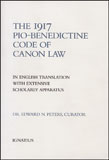
| The Pio-Benedictine Code, promulgated in 1917 and in force, as amended, in the Roman Catholic Church from 19 May 1918 through 26 November 1983, was the first integrated code of canon law in the Church. It replaced the Quinque Libri Decretalium (1234) of Pope Gregory IX that had governed the Church for nearly seven centuries. The 1917 Code was abrogated by the Johanno-Pauline Code of 1983.
Orientation
• Master Page on Pio-Benedictine Code, here.
Text
• 1917 Code, Versio originalis (original Latin), here.
Research
• Pan-Textual Commentaries on 1917 Code (list), here. • 1917 Codex Quondam (professional apparatus), here.
|
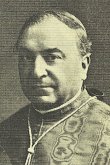
Architect of the 1917 Code |
|
1983 Code
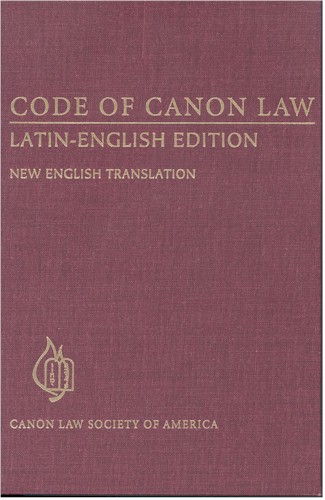
| The Johanno-Pauline, or Western, Code, in force, as amended, since 27 November 1983, is the primary legislative document of the Roman Catholic Church. The 1983 Code replaced the Pio-Benedictine Code of 1917 and, alongside the Code of Canons of the Eastern Churches of 1990, governs the faith life of over one billion Catholic Christians around the world.
Orientation
• Master Page on Johanno-Pauline Code, here.
Texts
• 1983 Code, Versio originalis (original Latin, facilitated), here. • 1983 Code, Versio currens (current Latin, facilitated), here. • 1983 Code, Current English (facilitated text), here. • 1983 Code, Current English (Vatican website), here.
Research
• Pan-Textual Commentaries on 1983 Code (list), here. • 1983 Codex Vigens (professional apparatus), here and here.
|
By their very nature canonical laws are to be observed.
John Paul II
|
|
Eastern Code
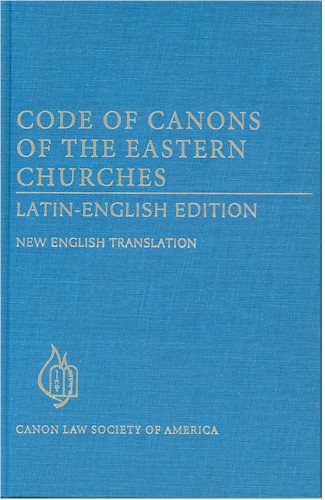
| The Code of Canons of the Eastern Churches, in force, as amended, in all Eastern Catholic Churches since 1 October 1991, is the first integrated code of canon law for the Eastern Catholic Churches. The Eastern Code replaced scattered legislation that had, in part, governed the Eastern Churches during the second half of the twentieth century. The Eastern Code stands alongside the Johanno-Pauline Code of 1983 as a primary legislative document of the Catholic Church today.
Orientation
• Master Page on Eastern Canon Law, here.
Texts
• 1990 Code, Versio originalis (original Latin), here. • 1990 Code, Versio currens (current Latin), here. • 1990 Code, Current English (Vatican website), here.
Research
• Pan-Textual Commentaries on Eastern Code (list), here. • 1990 Codex Vigens (professional apparatus), here.
|
I exhort the faithful to carry out these precepts with sincere hearts and good will; there is nothing that will more exceptionally serve the Eastern Churches than disciplined care for the souls of the Christian faithful, that they may flourish more and more and carry out the duty entrusted to them.
John Paul II |
| Collected Canon Law
St. Raymond
|
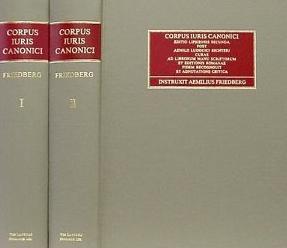
For several hundred years before it was codified, canon law had been 'collected', that is, it was found within larger or smaller collections of materials, some of which collections were official, others of which were merely private. Most of these materials were eventually organized into a group of texts known as the Corpus Iuris Canonici (itself a partly official, partly un-official collection).
Orientation
• Master Page on the Corpus Iuris Canonici, here.
Texts & Research
• Quinque Libri Decretalium, or Decretals of Gregory IX (an official collection of canon law, in force from 1234 to 1918 until the advent of codified canon law). • Master Page on the Ius Decretalium (1234), here. • Resource Page on Ius Decretalium, here.
• Concordia discordantium canonum, or Gratian's 'Decree', (an unofficial collection of canon law complied about 1140). • Master Page on Gratian's Concordia, here.
|
Corpus Iuris Canonici
|
| Ancient Canon Law
|
During the 1,000 or so years before Gratian, ancient canon law, the Ius Antiquum, had been scattered through a myriad of documents. Most of these materials are now lost, but some outstanding works, increasingly sophisticated attempts toward systematic collections, survive to this day.
Orientation
• Master Page on Ius Antiquum, here. |
Burchard of Worms |

| Selected topics
Is this man a saint?
|
Popular pages Basic introductions to canon law, here. Overviews of history of canon law, here. Considering canon law school, here.
Canonical research tools
Modifications to codified law, here. Academic Works on Canon Law, here. Directory of writings, developing, here. The Second Vatican Council, here. The First Vatican Council, coming. The Council of Trent, coming. Roman Law (Corpus Iuris Civilis), here. |
Current controversies Canon 0277, obligatory clerical continence, here. Canon 0983, seal of Confession, here. Canon 0915 & 0916, Communion participation, here. Canon 0919, extending the Communion fast, here. Canon 1055, Sine matrimonio nullum Matrimonium, here. Canon 1108, eliminating canonical form, here. Canon 1184, funeral controversies, here. Canon 1314, eliminating automatic penalties, here.
Other
Canon Law Blog, here.
|
| Abbreviations in these pages might include: | AAS CCC CCEO CIC CLD CLSA |
Acta Apostolicae Sedis (1909 et seq.) Catechism of the Catholic Church (1992/1997) Codex Canonum Ecclesiarum Orientalium (1990) Codex Iuris Canonici (1917 or 1983) Canon Law Digest (beginning 1933) Canon Law Society of America | Comm. DDC DMC NCE NCE(2) QLD =, ≈, ⌂ | Commentary (≠ Communicationes!) Dictionnaire de Droit Canonique (1935-1965) Dictionarium Morale et Canonicum (1962-1968) New Catholic Encyclopedia (1967) New Catholic Encyclopedia, 2nd ed. (2003) Quinque Libri Decretalium (1234) editorial markings (disregard) |
| Purchases made through Amazon links provide me a small commission that help cover site costs. |
Materials on this website represent the opinions of Dr. Edward Peters and are offered in accord with Canon 212 § 3. This website undergoes continual refinement and development. No warranty of completeness or correctness is made. Dr. Peters' views are not necessarily shared by others in the field nor are they intended as canonical or civil advice.
CanonLaw.info Homepage & Site Directory / Original Materials © Edward N. Peters |
|
| My Poor Poe Page, here / Hillbilly Thomist, here / Languages, here / Tamarack Transcriptions, here / OE-ME, here / VTM, here. |