|
Dr. Edward Peters American Canonist |
CanonLaw.info Homepage and Resource Center of Edward Peters, JD, JCD, Ref. Sig. Ap.
Edmund Cdl. Szoka Chair, Sacred Heart Major Seminary, Detroit Referendary, Supreme Tribunal of the Apostolic Signatura, Rome
|
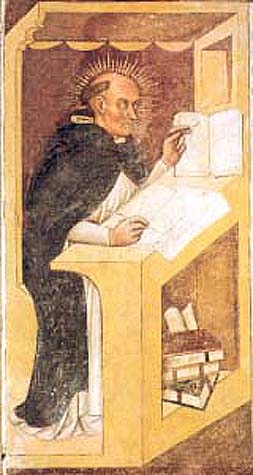
St. Raymond Peñafort Patron of Canonists |
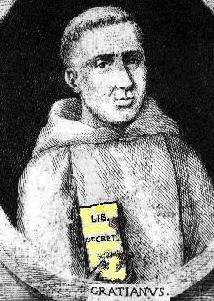
Is this man a saint? |
|
Gratianus Iuris Canonici Pater
Understatement of the Decade
In recent years the study of Canon Law underwent, for various reasons, a lessening of interest, especially among ecclesiastical students. This trend has had a certain disorientating effect upon the Church.
Cong. for Cath. Educ. 2 apr 1975 |
Canon Law is the internal legal system of the Catholic Church:
• internal: the content of canon law lies within the Church's authority to compose and administer, in contrast to the wide variety of external (usually civil) laws to which the Church generally defers in the pursuit of her divine mission;
• legal: canon law operates according to the principles of law chiefly as set out in Aristotelian-Thomistic legal philosophy, in contrast to suggestions that canon law is simply applied theology, morals, or the rules of religious cult;
• system: canon law must be read as a whole for proper understanding and use, in contrast to suggestions that canon law is a collection of principles or aphorisms that are capable of being rightly appreciated in isolation from each other.
As the oldest continuously functioning legal system in the western world, canon law affects virtually every aspect of the faith life of over one billion Catholic Christians around the world. But, as Pope John Paul II explained when he promulgated the Code in 1983, canon law "is in no way intended as a substitute for faith, grace, charisms, and especially charity in the life of the Church and of the faithful. On the contrary, its purpose is rather to create such an order in the ecclesial society that, while assigning the primacy love, grace, and charisms, it at the same time renders their organic development easier in the life of both the ecclesial society and the individual persons who belong to it." John Paul II, ap. con. Sacrae disciplinae leges (1983) 16.
Leges Ecclesiae conservant libertatem Spiritus Sancti! Church laws work to preserve the freedom of the Holy Spirit. The more that Catholics understand their canonical rights and duties, the more effectively they can partake in the Church's mission. |
Quick Links to
Sacraments for children in danger
|
|
Codified Canon Law
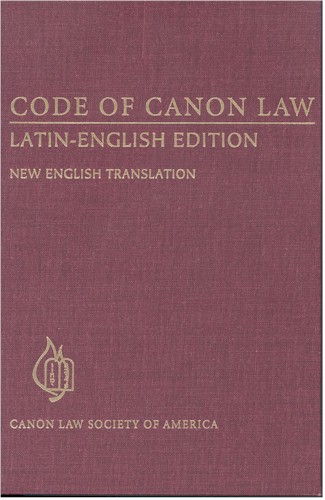
1983 Code
|
Modern Catholic canon law is "codified", that is, it is contained within, presently, two integrated "codes" (one for the Roman Church, one for the Eastern Churches).
Master Page on the Johanno-Pauline Code, in force in the Roman Catholic Church since November 26, 1983.
The Johanno-Pauline Code of 1983 is the primary legislative document of the Roman Catholic Church. Promulgated by Bl. Pope John Paul II on 25 January 1983 and taking force on the First Sunday of Advent that year (26 November), the 1983 Code replaces the Pio-Benedictine Code of 1917 and, alongside the Code of Canons of the Eastern Churches of 1990, governs the faith life of over one billion Catholic Christians around the world. Quick Links: 1983 Code (Latin) • 1983 Code (English). |
|
|
1917 Code |
Master Page on the Pio-Benedictine Code, in force in the Roman Catholic Church from May 19, 1918, through November 25, 1983.
The Pio-Benedictine Code of 1917, the first integrated code of canon law in the Catholic Church, was promulgated by Pope Benedict XV on 27 May 1917 and took full force on Pentecost 1918 (19 May). It replaced the Quinque Libri Decretalium (1234) of Pope Gregory IX that had governed the Roman Church for several centuries. The 1917 Code was abrogated by the Johanno-Pauline Code of 1983. Quick Links: 1917 Code (digitized).
|
|
|
Eastern Code
|
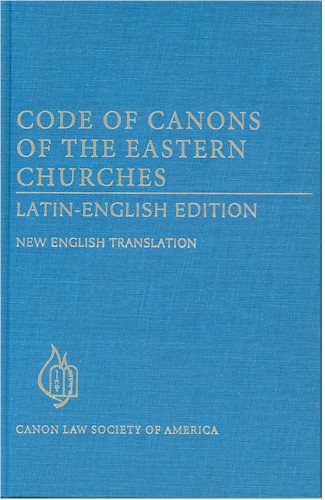
Master Page on Eastern Catholic Canon Law, in force in all Eastern Catholic Churches since October 1, 1991.
The Code of Canons of the Eastern Churches is the first integrated code of canon law for the Eastern Catholic Churches. Promulgated by Bl. Pope John Paul II on 18 October 1990 and taking force on 1 October 1991, the Eastern Code replaced the four motu proprios that had, in part, governed the Eastern Catholic Church during the second half of the twentieth century. The Eastern Code stands alongside the Johanno-Pauline Code of 1983 as a primary legislative document of the Catholic Church today. Quick Links: Eastern Code (Latin) • Eastern Code (English)
|
Codificatio Iuris Canonici Orientalis
I - IV
|
|
Collected Canon Law |
For many centuries Catholic canon law was "collected", that is, it was found within compendia of official documents, some of which compendia were themselves official, while others were merely private.
|
|
St. Raymond working on the Ius Decretalium |
Ius Decretalium or Decretals of Gregory IX (an official collection, in force from 1234 to 1918) Master Page
Gratian's Concordantia (an unofficial collection, complied about 1140) Master Page
Corpus Iuris Canonici (a partly official, partly unofficial collection, 1140-1522) Master Page
Ius Antiquum (scattered unofficial collections, prior to Gratian's Concordantia) Master Page
|
The Corpus Iuris Canonici (Yale University) |
|
Selected Issues in Canon Law
|
Canon law, like the Church it serves, undergoes continual renewal and reform. I keep track of, and try to contribute to, several such topics, including the following:
Canon 0277 on obligatory clerical continence, here Canon 0915 on withholding holy Communion, here Canon 0919 on extending the Communion fast, here Canon 1083 on raising the age for licit marriage, here Canon 1108 on modifying canonical form for marriage, coming Canon 1184 on ecclesiastical funeral rights, here Canon 1248 on the satisfying of Mass obligations, coming Canon 1314 on abolishing latae sentenitae penalties, coming Canon 1336 on certain types of ecclesiastical punishments, coming Canon 1398 on human life issues, coming |
|
|
Leading officials in canon law
Francis Legislator |
The provisions of canon law are neither self-evident nor self-enforcing. Like every legal system on earth, canon law relies on people to make it work.
Ecclesiastical governance can be distinguished into legislative, executive, and judicial components (c. 135 § 1) but, for reasons rooted in the divine constitution of the Church (see Matthew XVI:18) and in the ancient Roman law whence springs the basic structure of modern canon law, legislative authority is central in the Church. Atop the canonical system sits, therefore, the pope, known to canonists as "the Legislator".
Three Roman dicasteries participate most directly in the elaboration and application of canon law: first, the Apostolic Signatura (c. 1445), then the Roman Rota (c. 1444) and the Pontifical Council for Legislative Texts (c. 16 § 1). |
|
● The too rapid growth of practice without a clear and solid theoretical foundation has its most serious consequences in confusion regarding the very foundations of law. R. Burke, Discretion of Judgment (1986) at 85.
|
Cdl. Burke Prefect, Supreme Trib. Apostolic Signature |
Abp. Daneels Sec., Supreme Trib. Apostolic Signatura |
Msgr. Pinto Dean, Roman Rota |
Cdl. Coccopalmerio Prefect, Pont. Council for Legislative Texts |
Abp. Arietta Sec., Pont. Council for Legislative Texts |
|
Getting started in canon law |
Getting started in canon law can be as simple as picking up a copy of the Code and reading through it—which is what I did back in 1980 when I happened upon this thing called "canon law" during a legal history seminar at Tate Hall. As it turned out, I was actually reading a commentary on something called the "Pio-Benedictine Code" (having never heard of either Pius or Benedict) written by, as I was later to learn, the great American canonists Bouscaren & Ellis, which Code, as it happened, was being completely revised at the time, but, never mind, I was hooked. I perused those pages unaware of just how deep were the waters into which I was wading.
|
| A professional knows the limits of his knowledge. An amateur does not know the limits of his knowledge. A dilettante does not know that there are any limits to his knowledge. |
If the cold reading of a legal tome is not your cup of tea, trying starting with Pope John Paul II's introductory essay (actually, it's an "apostolic constitution" but no need get technical yet) to the 1983 Code, "Sacrae disciplinae leges", remarks that are, by the way addressed to all "members of the people of God". After that, one might want to look some short essays by me, namely:
• A Catechist's Introduction to Canon Law (1997) • A Simple Overview of Canon Law (1994) • What Canon Lawyers Are and Aren't (1991) • Introductions to Canon Law, here. |
Open up the Code of Canon Law . . .
and suddenly everybody wants to sit at your table. |
|
Basic steps for researching Roman Catholic canon law
Standard Reference Works on Canon Law, here
|
All serious canonical research begins with the text of the law.
To access the 1983 Code of Canon Law in its authoritative Latin text, go here; for an authorized English translation of the 1983 Code, go here; better, though, to obtain a hard copy of: Canon Law Society of America, Code of Canon Law, Latin-English Edition, New English Translation (Canon Law Society of America, 1999) which provides the original Latin and an improved English translation, the official footnotes of the Code, good indexes, and some important supporting documentation (such as ap. con. Pastor bonus on the Roman Curia). For a list of other authorized vernacular translations of the 1983 Code, go here.
A small but very important point to assess is whether the canons in question have been subject to "authentic interpretation" (c. 16 § 2), as listed here. Additionally, the possibility that a canon or group of canons have been treated in one or more "instructions" (c. 34) must be considered.
Once the relevant canonical texts have been identified, canonical research takes one of two main directions, what I call "contemporary" or "historical". Often, both avenues must be explored for a solid understanding of the law; but most researchers will be with contemporary resources.
|
|
• Contemporary research |
Canon law, for reasons rooted in the legislative supremacy characteristics (c. 16) of the ancient Roman law whence it springs—and which characteristics best reflect the ecclesiological implications of the divine constitution of the Church—makes extensive use of scholarly commentary for the elucidation of legal materials. The first place one looks for canonical commentary today is the great pan-textual commentaries on the 1983 Code. Next one turns to scholarly articles in peer-reviewed canon law journals and to canonical monograph series (see Rhode's list of publications here, and the GB&I index of articles here) and/or to doctoral dissertations in canon law (North American productions listed here). Of special relevance to American researchers would be treatments of canonical topics found in the convention proceedings of the Canon Law Society of America and the annual Advisory Opinions produced by the CLSA.
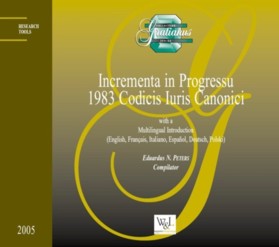
In transitioning from "contemporary" research in canon to "historical", one will often benefit by examining the legislative history of the canons in question, which development can now be traced easily in Edward Peters, Incrementa in Progressu 1983 Codicis Iuris Canonici (Wilson & Lafleur, 2005) 1549 pp. Other resources for conducting legislative history research are listed here. |
|
• Historical research
|
The 1983 Code did not drop ready-made from heaven, it did not leap Athena-like from the head of the pope, and it was not drafted by the Conciliar Fathers in the final sessions of Vatican II. Rather, the 1983 Code represents the most recent formulation of a legal system that traces its roots to the ancient Church, and indeed beyond. |
|
|
the most important canonist from Peñafort to Gasparri.
|
The two most important and direct sources for the 1983 Code are the Pio-Benedictine Code of 1917 and the documents of the Second Vatican Council (1962-1965). More about researching the Second Vatican Council, here.
The authoritative Latin text of the Pio-Benedictine Code of Canon Law, often called the 1917 Code (and occasionally, though infelicitously, the 1918 Code) can be found in PDF here; the most useful English translation of the 1917 Code is mine: Edward Peters, The 1917 or Pio-Benedictine Code of Canon Law in English Translation with Extensive Scholarly Apparatus (Ignatius Press, 2001) 777 pp., offering correlations to the 1983 Code, references to developments of the law as recorded in the Canon Law Digest, and citations to English language canonical dissertations on canons and groups of canons in the Code. There are two Spanish translations of the entire 1917 Code and a number of good English paraphrases of some or nearly all of the 1917 Code in various pan textual commentaries thereon. As with the 1983 Code, serious research into the 1917 Code will make use of journal articles (for which no comprehensive indexing is available), topical monographs (again, most of which must be found the old-fashioned way), and canonical dissertations (some of which are listed here), others of which can be found [here].
Researching pre-codified canon law, that is, canon law as it existed prior to the 1917 Code, is possible, of course, and at times very useful. Such research requires facility with the footnotes of the Pio-Benedictine Code (techniques explained here) and access to the Corpus Iuris Canonici, especially the Quinque Libri Decretalium and its host of commentators (some of whom are listed here). |
|
CANONICAL LANGUAGES |
Latin is the official language for canon law, but English, French, German, Italian, and Spanish are vital for modern canonical research. Important canonical material is also found in Polish, Portuguese, and Dutch. |
|
Frankfurt Jesuit canonist Ulrich Rhode maintains a very useful canon law website. Most materials in German, of course, but also considerable materials in English.
Fr. John Boyle, an English canonist in Michigan parish work, blogs the Truth in Charity.
|
The Law: Do other professions boast such powerful patrons?
|
|
|
"Christ among the Doctors of the Law" (Paolo Caliari, 16th century) |
|
Other areas of special interest include
• Look, guys, you have to know where various topics are treated in the Code. Nobody wants to sit around while you leaf through the book looking for canons. R. Kennedy, CUA
• Compassion without competence is a cruel hoax. J. Provost, CUA.
|
In recent years there has been a growing desire among Catholic writers to see canon law as an expression of theology and particularly of ecclesiology. The structure of the Church, they maintain, should reflect the theology of the Church and the laws which establish and protect these structures ought to be a faithful expression of dogmatic theology. These laws should be, and should be seen to be, dogmatic theology in the concrete, theology in action, applied doctrine. Gallagher, Canon Law (1978) at 90.
|
Dr. Peters served as an Adiutor Secretarii Specialis (Expert) for the XIII° Ordinary Assembly of the Synod of Bishops on the New Evangelization (Rome, October 2012). |
|
AAS ap. con. ASS CE CUA CIC CLD DDC DOB DTC m. p. NCE NCE2 Pont. PP L'OR RR SDL SRRD USCCB |
throughout this website — apostolic constitution — [Old] Catholic Encyclopedia — The Catholic University of America — Codex Iuris Canonici — Canon Law Digest — Dictionnaire de Droit Canonique — Defender of the Bond — Dictionnaire de Theologie Catholique — motu proprio — New Catholic Encyclopedia — New Catholic Encyclopedia, 2nd ed — Pontifical — Petitioner — L'Osservatore Romano — Respondent — Sacrae disciplinae leges — Sacrae Romanae Rotae Decisiones — U. S. Conference of Catholic Bishops |
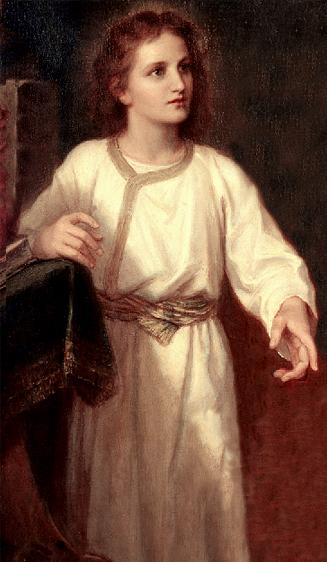
Christ and the Doctors of the Law (Luke II: 46-47)
My favorite among so many splendid representations. I see in this painting the four stages of a lawyer's career. |
|
If we're taking a poll, put me down as:
|
opposed to:
• Using the Communion procession as a blessing line (2009); • Distributing from the Cup more than twice or thrice a year; • Observing the mandatum rite in parish liturgies (2006); • The celebrant using the orans during the Pater noster (2005);
and in favor of:
• Making the Annunciation (March 25) a holy day of obligation.
|
|
|
You should also learn to understand and—dare I say it—to love canon law, appreciating how necessary it is and valuing its practical applications: a society without law would be a society without rights. Law is the condition of love! Benedict XVI to seminarians 18 October 2010 |
|
|
To work for the proper implementation of the Code is to work for the up-building of the Church. It is to play an extraordinarily constructive role in continuing the mission of Christ. John Paul II |
|
All Original Materials © Edward Peters 2013
|
Notice: The materials on this site represent the opinions of Dr. Edward Peters and do not necessarily reflect the views of others with whom he might be associated. Materials offered here are for informational and educational purposes only and are not intended as civil or canonical advice. I strive to present my views in accord with Canon 212 § 3, but I submit all to the judgment of the competent ecclesiastical authority. |